

The East Jersey Colony
Much of the historical material that is presented here was derived from the book Scotland and Its First American Colony, 1683-1765 by Ned C. Landsman, Princeton Univ. Press.
The "East Jersey Colony," established in the 1680's by an organized group of prominent lowland Scottish families, has become a forgotten chapter in our country's history. Because these people came here mostly as part of an economic venture and were not fleeing persecution or poverty, this wave of immigration is not as well known as that of the Pilgrims and other famous groups. However, even though the colony eventually failed its intended purpose, many descendants of the original colonists stayed in this country and merged into the cultural mainstream. This was where several generations of my Gordon ancestors lived when they first came to these shores.
One reason why this is not remembered as a major Scottish immigration is that the lowland families had names that we do not immediately recognize as Scottish: Barclay, Hampton, Craig, Fraser, and others. The more famous Scots-Irish wave of immigration was in the 1700's in the Appalachian area when families such as the MacLeans, MacDonalds, Campbells, and all the rest arrived here. These were the better known highland clans with colorful histories that come to mind when most people think of Scotland.
History of the Colony
One distinction of the East Jersey colony is that it was a venture of the lowland Scottish families. The lowlands had more of an organized agricultural economy at this time, whereas the highland families lived in more primitive conditions in their rugged terrain. Looking at a map, the Gordon lands near Aberdeen are in the northern region of Scotland, which is usually thought of as part of the highlands. However, Aberdeen is actually on the coastal plain of the country and was much more closely tied to the lowland society and economy than to the highlands.
Many of the original founders, or "proprietors" of the colony belonged to the Quaker church. In fact, William Penn (of Pennsylvania fame) was involved in a related effort to establish a large English Quaker settlement in the Delaware Valley area, and had some influence in bringing the Scottish Quakers into the area. The initial Quaker proprietor and governor was Robert Barclay, laird of Urie. Among the other early major proprietors was "Robert Gordon of Cluny," who was related to us but was not a direct ancestor. Other families associated with Barclay in the East Jersey venture were the Gordons of Straloch and Pitlurg, including our possible ancestor Robert Gordon (son of Robert Gordon of Straloch).
The first settlement was in the area of the city of Perth Amboy. It was a carefully planned settlement, with each of the various proprietors and fractioners being given plots of land according to their individual shares. It is interesting to note that there were several different classes of people that made up the early population of the colony:
The proprietors themselves were the highest class of resident. However, many of them never actually made the trip to the colony, but left the management of their shares to overseers or other family members. Younger sons of the proprietors were often given shares in the colony since they would otherwise not have had an opportunity for a lairdship or other high position in Scotland due to the inheritance laws. Charles Gordon, Robert's son, may have been in this situation.
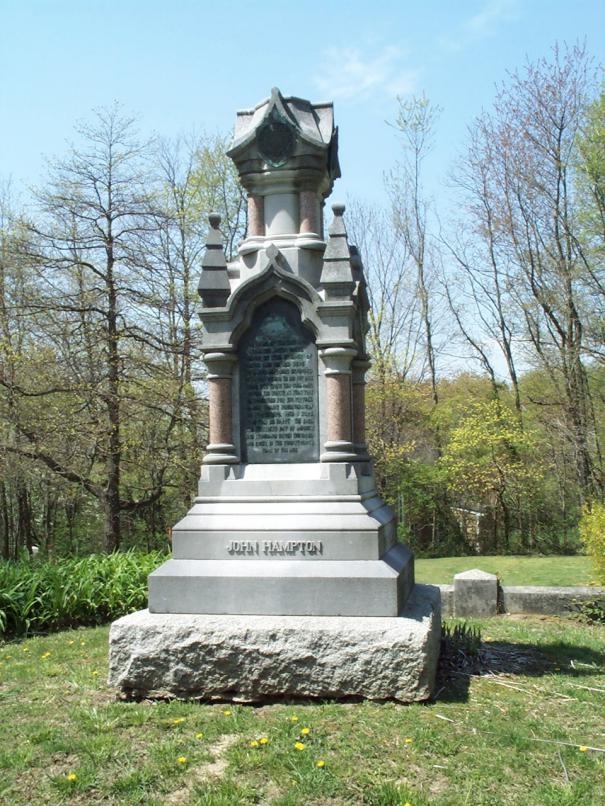
| Monument honoring John Hampton and others in Old Scots Graveyard, Monmouth Co., New Jersey |
In lieu of family members, the proprietors used paid overseers to look after their interests. Some of these, such as our ancestor John Hampton, eventually established their own families and acquired other property in the colony. Indentured servants provided much of the early labor force. Over time, some of these worked out their terms of service and were able to purchase land of their own and become permanent residents.
Most of this phase of immigration took place between about 1683 and 1700. After that time, there were fewer arrivals in the colony, and the families that lived there began to spread into land to the west of Perth Amboy. A factor in this tendency was that in 1702 the proprietors gave up direct control of the East Jersey colony, which then officially merged with the English colony of West Jersey to become the Royal Colony of New Jersey. The counties of Middlesex, Monmouth and Hunterdon were some of the prominent destinations, and here the Scottish settlements started to intermingle with the English settlements that already existed there. The Scots and English generally considered themselves as being culturally distinct from each other, so that each town that one might encounter would tend to have either a definite Scottish or English character. Of course, intermarriage was inevitable and these distinctions eventually broke down.
The direct Scottish involvement with the original colony ended in the 1760's. By this time, most of the original proprietary families had sold their holdings or otherwise simply returned to Scotland. In addition, with the outbreak of the Revolutionary War, all those with Loyalist tendencies were forced to either fight or flee. In any case, the Scottish population now included a generation or two who were essentially native to the New Jersey Colony, and who "stayed behind" to become early citizens of the new United States of America. They eventually blended into the overall population to the point where the details of their Scottish origins were largely forgotten.
Early Gordons in East Jersey
Robert Gordon had three sons who traveled together to the East Jersey colony in about 1681: Dr. John Gordon, Thomas Gordon, and Charles Gordon. Not much is known about John's fate, but Thomas and Charles both secured land in Perth Amboy. An early map of the platting of the area clearly shows the holdings of "T. Gordon" and "C. Gordon." The attraction of the colony in its early stages is illustrated by a letter that Charles wrote to his cousin, Andrew Irvine of Edinburgh, on March 5, 1685:
If any pleases to tell me what their scruples are, I shall endeavor to answer them, if servants knew what a Countrey this is for them, and that they may live like Lairds here, I think that they would not be so Shey as they are to come; and during their service they are better used than in any place in America I have seen.
Fishing by the inhabitants is very plentiful; the fish swim so thick in the Creeks and Rivers at Certain seasons of the year that they bail them out of th water with their hands.
Several thousand people are here already, and no want of good company, as in any place in the world. I intend to follow Planting myself, and if I had the small stock here I have in Scotland, with some more servants, I would not go home to Aberdeen, for a Regencie as was proffered me; neither do I intend it; however, hoping to get my own safely over.
We are not troubled here leading our pitts, mucking our Land and Ploughing 3 times; one Ploughing with 4 or 6 oxen at first breaking up with two horses only thereafter, suffices for all; you may judge whether that be easier Husbandrie than in Scotland.
Fortunately for us, several of Charles' letters to Scotland have become a part of various historical collections. The following is another letter that he wrote, describing his impressions of the new colony:
A Letter for Mr. Robert Paterson Principal of Marischal College
in the City of New Aberdeen. in Scotland.Woodbridge, in East Jersey
in America, March the 7th, 1685Sir, I Hope you have heard of our Voyage and safe Arrival here. I thought it my duty to present my dutiful respects to you and all Friends at Aberdeen and to acquaint you of mine own and all their welfares who came over the last year, all which intend to settle in tbe Countrey except ------, who has spent all his means already foolishly on drink, and is returning home for more. You have David Barclay and Arthur Forbes to inform you of this Countrey: when I have seen it through all the Seasons of the year as they did, I shall then give you my opinion, if you be desirous: only in short, what I have seen I may write, --that it pleases me better than Virginia, Maryland, Pensilvania, or West Jersey, --that it is pleasant to mine eyes, and I find it healthful to my body. I am not troubled here (blessed be to God) with defluctions, head aikes, and coughs, as at Edinburgh: that the land is furnished with all conveniencies of Nature, such as Wood, Grass, Meadow, and abundance of fresh Water Springs, Brooks and Rivers, and plenty of Deer, Turkies, Geese and Ducks; many tender Herbs, Fruits and Trees grow naturally here that will not grow in Scotland at all: these things are so notoriously known, that it is superfluity to write them, and no unbyassed person will deny them, or speak ill of the land. There is about a duzon or 14 houses in New Perth, and the half of those built since we came; several others are building presently, and many others have taken Lotts to build; Mr. Mudie is building a stone house, and has a Horse Mill ready to set up; Governour Rudyard intends another Stone house this Summer. --The Governours house, and the publick Court-house are abuilding. It is the best scituate for a City of any yet I have seen, or for ought I can learn, of any yet known in America. There is great encouragement here for all kind of Tradesmen: I intend myself to follow mostly Planting and Fishing. Let this remember me to all my Friends, Relations, Comorads and Acquaintances at Aberdeen; I could not write to them all, being busied about mine own setlement, and it is now far spent in the year, so that I do not expect to do much this year; neither could I settle sooner, by reason that my bed-cloaths are not yet come from Maryland, and the land I intend to settle on is not yet purchased from the Indians. I intreat to hear from you on all occasions, and what remarkable News abroad or at home, and how the Civilists place is disposed of. My service to yourself and bedfellow.
I am Sir, Your most affectionate and humble Servant Charles Gordon.
Thomas was the more prominent of the two brothers, and started a line that has many descendants down to today. Charles, on the other hand, died intestate in 1698, leaving behind only a few possessions.
At about this time, the records indicate the presence in the colony of two brothers, Charles and Peter Gordon in Monmouth County. In the well known book This Old Monmouth of Ours it is stated that this Charles is assumed to be the son of the Charles who is quoted above. This is almost certainly wrong for several good reasons. However, it is also obvious that these two were well-connected and probably part of the same family, descended from the Gordons of Pitlurg and Straloch. We can trace our descent from this Charles Gordon, and hope to someday establish the definitive link back to Scotland.
Charles Gordon
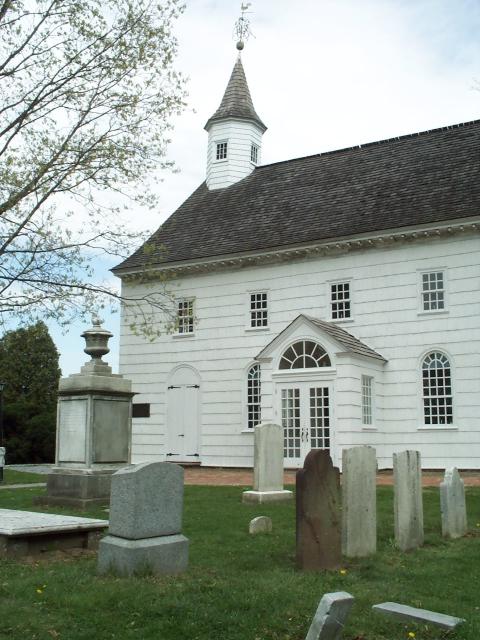
| Old Tennent Church Freehold, New Jersey |
In about 1700, the colony was expanding to the west into Monmouth County. Charles and Peter moved to the area near the town of Freehold about this time. Charles married Lydia Hampton, daughter of John Hampton, the chief overseer of Robert Barclay's holdings in the original colony. John Hampton was a Quaker, but Lydia must have converted to Charles' church. His brother, Peter, married Elizabeth Rhea (granddaughter of John Hampton) and started a line that also continues to this day.
One of the landmarks of the Freehold area, still standing as a historical site today, is the Old Tennent Church that was built in 1730. Charles helped establish this church and was one of the elders; his name is mentioned numerous times in the church archives. Charles died in 1740 and is probably buried in the Old Scots graveyard, near the site of the original church. There is a legend about the founding of this church that involves one of our relatives, Janet (Hampton) Rhea, half-sister of Charles' wife Lydia. It is said that the elders were having a heated discussion over the choice of sites for the church, arguing between a spot on a hill and in a low area. While this was going on, Janet picked up the cornerstone and moved it into its present position on the hill, while exclaiming in her Scottish dialect:
"Wha ever heard o' ganging doon to the House o' the Lord, an no o' ganging oop to the House o' the Lord?"
Peter Gordon
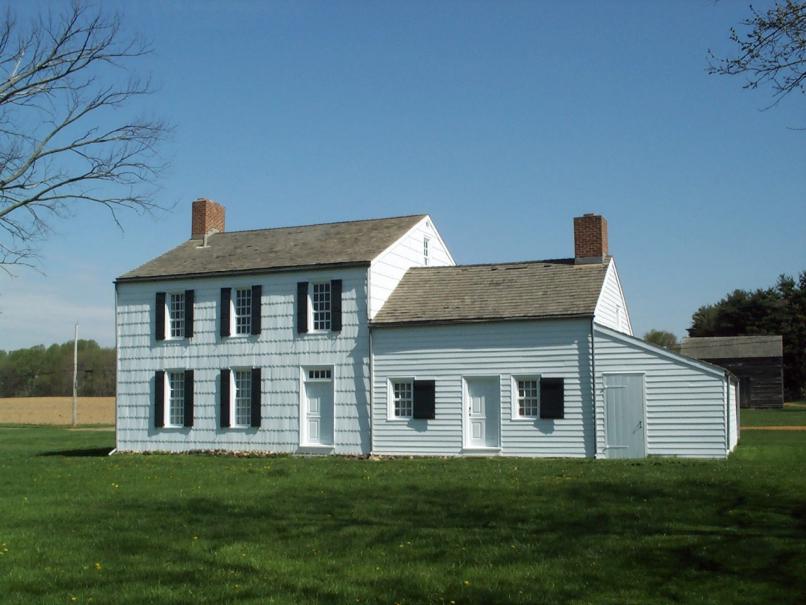
| Craig House Monmouth Battlefield Park |
Charles and Lydia had a large number of children whose descendants are with us today. One of these, born May 7, 1703, was Peter Gordon -- the first of several by that name in the generations that followed (not to be confused with the Peter Gordon who was Charles' brother).
Peter was first married to Margaret Melvin and had seven or more children by her before her death. He then married Mary Craig, daughter of Archibald Craig, in 1742. Archibald was also an elder of the Tennent Church along with Peter's father, Charles. Near Freehold today, one of the historical attractions is the Craig House that belonged to one of Archibald's sons who was an officer in the Revolutionary War. The house dates from about 1708, so it must have originally been built and occupied by Archibald himself. This is probably the oldest family home of any of our ancestors in this country that is still standing.
Peter had another eight children with Mary, although by this time he was into his 50's. In the family bible, there is an entry for "Lues [Lewis] Gordon, July 7, 1754." Two lines below, there is another entry for "Lues Gordon, June 6, 1762." It was not unusual in those days to give a child the same name as one that had died earlier. Peter and Mary's first son named Lewis must have died in infancy, and the name was then given to their next son.
Lewis Gordon
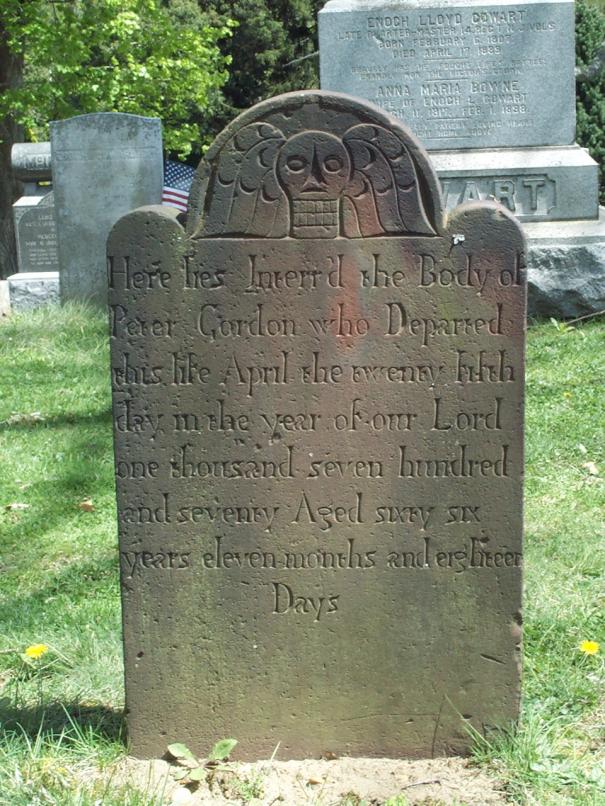
| Peter Gordon's grave at Old Tennent Church |
Lewis Gordon was the last child of Peter and Mary Gordon. Peter died in 1770 when Lewis was only 8 years old. As the youngest of their children, he probably came by little in the way of inheritance. In actuality, we know nothing of the history of his childhood.
At the time of the Revolutionary War he would have been in his teens and is not known to have served in any capacity. However, the people in that area were certainly not untouched by the war itself. In June of 1778, the Battle of Monmouth took place in the area. This was one of the significant battles of the war, and was the place where the story of the heroine "Molly Pitcher" took place. There is today a military historical park on the site of the battle, including the above-mentioned Craig house, which was used as a command post and hospital.
Lewis is included on the tax rolls for Freehold Twp, Monmouth Co., for the years from 1784 through 1790. The records have not been located yet, but we can assume that some time during this period Lewis took the next big step in his life when he married Keziah Stout of nearby Hunterdon Co.
The Stouts
The Stout family also has a long history in the New Jersey area, and in fact it is in this family line that we find our first known ancestor to arrive on these shores. The first part of the story involves Penelope Van Princis, a woman who set out for the Dutch colony of New Amsterdam (now New York City) with her first husband in about 1620 (or 1640). The tale has been told in several different ways. The following is from a Stout family history that was written in the early 1800's:
The origin of this Baptist family is no less remarkable: for they all sprang from one woman, and she as good as dead; her history is in the mouths of most of her posterity, and is told as follows: "She was born at Amsterdam, about the year 1602; her father's name was Vanprincis; she and her husband (whose name is not known,) sailed for New York, (then New Amsterdam,) about the year 1620, the vessel was stranded at Sandy Hook; the crew got ashore and marched toward the said New York; but Penelope's (for that was her name) husband being hurt in the wreck, could not march with them; therefore, he and the wife tarried in the woods; they had not been long in the place before the Indians killed them both (or they thought) and stripped them to the skin; however, Penelope came to, though her skull was fractured, and her left shoulder so hacked, that she could never use that arm like the other; she was also cut across the abdomen, so that her bowels appeared; these she kept in with her hand; she continued in this situation for seven days, taking shelter in a hollow tree, and eating the excrescence of it; the seventh day she saw a deer passing by with arrows sticking in it, and soon after two Indians appeared, whom she was glad to see, in hope they would put her out of her misery; accordingly, one made towards her to knock her on the head; but the other, who was an elderly man, prevented him; and, throwing his matchcoat about her, carried her to his wigwam, and cured her of her wounds and bruises; after that he took her to New York, and made a present of her to her countrymen, viz. an Indian present, expecting ten times the value in return.
It was in New York, that one Richard Stout married her: he was a native of England, and of a good family; she was now in her 22d year, and he in his 40th. She bore him seven sons and three daughters, viz: Jonathan, (founder of Hopewell,) John, Richard, James, Peter, David, Benjamin, Mary, Sarah, and Alice; the daughters married into the families of Bounds, Pikes, Throckmortons, and Skeltons, and so lost the name Stout; the sons married into the families of Bullen, Crawford, Ashton, Traux, &c., and had many children. The mother lived to the age of 110, and saw her offspring multiplied into 502, in about 88 years.
It is thought that the dates of Penelope's arrival (and assumed birth) could be off by about 20 years, making her a more reasonable 90 years old at her death. In any case, we are talking here about a very hardy woman! This story has become a part of the established history of the state of New Jersey, and there is also a historical marker about her located near the farm where she lived.
Her second husband, Richard Stout, also had an interesting origin. He was born to parents John Stout and Elizabeth Bee in Nottinghamshire, England. He served for seven years as a sailor on a British man-o'-war before taking his discharge while the ship was in port at New Amsterdam. At some point he then managed to meet and marry Penelope.
After their marriage, Richard and Penelope moved to the shoreline area of New Jersey, not far from the spot where she had originally been stranded. They were instrumental in establishing the first town in that area (Middletown), and then settled down to having a large family. The Stouts in fact were an extremely prolific family, and between the confusion of repeated first names and the somewhat frequent marriages of cousins, their genealogy can be very complex to describe.
One of their sons, Jonathan Stout, moved westward to what became Hunterdon Co. and helped to establish an early Baptist church in the town of Hopewell. This may have been significant to the way our family history developed, as will be seen later. Some generations later, John Stout and his wife Mabel Sexton had a family of seven children that included a daughter Keziah.
Lewis and Keziah's story continues in the next chapter.

