

The Kentucky Generations
The first "settler" in the Mason County area of Kentucky was the famous frontiersman Simon Kenton, who arrived near the present site of Maysville in 1775 and acquired some land a few miles in from the river. In 1785, 400 acres of his land were purchased for the establishment of the town of Washington. This town was one of the first to be incorporated west of the Alleghenies, and was also the first settlement (of many) to be named after George Washington.
When Mason County itself was formed, Washington became the county seat. A few years later, increased river travel led to the establishment of the riverfront town of Limestone, which was later renamed Maysville. Washington and Limestone/Maysville were rivals for a number of years, with Maysville's river location eventually allowing it to become the more dominant of the two. The county seat was moved to Maysville in 1848. "Old Washington" today is actually a part of Maysville, and has been restored as a historical district. There are a number of original buildings from the 1700's and 1800's that are open to the public today, and there is little doubt that some of our ancestors walked along those same streets 200 years ago.
Arrival in Kentucky
The first official record of Lewis Gordon as a resident of the county dates to 1799. As mentioned in the previous chapter, he was on the New Jersey tax list at least up through 1790. He had a daughter who was born in 1795 in New Jersey, so it was probably in about 1798 that they made the journey to Kentucky. His wife, Keziah Stout, had a sister named Rachel who was married to their second cousin, Jonathan Stout. The families were apparently very close as evidenced by the fact that Jonathan is buried in the same family plot with Lewis and Keziah, in the Old Washington cemetery. There is a record in the annals of the Hopewell Baptist Church that notes that Rachel Stout left the congregation in 1796, presumably when she emigrated to Kentucky. Her husband Jonathan was already in Mason Co. at that time, as his name shows up in the tax records of 1790. He had possibly gone ahead to establish a homestead in what was then a very rough frontier, and later sent for the rest of his family. It is then possible that Lewis's family joined Rachel, and perhaps a number of other Stout family members, and made the trip at the same time. There is an interesting account of a similar journey from New Jersey to Kentucky in 1795 that must contain many similarities to Lewis's travel experience.
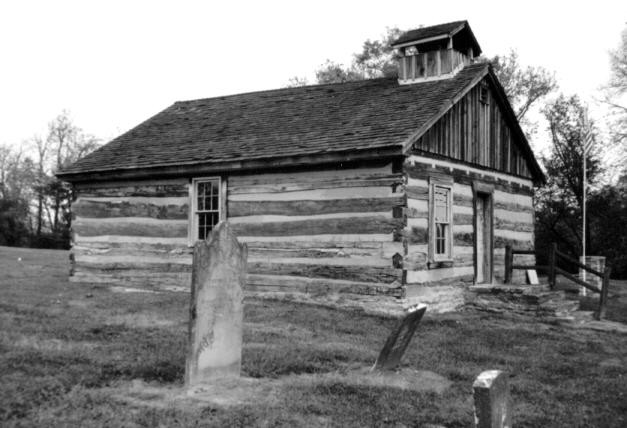
| Baptist church reconstruction near Old Washington, Kentucky |
There could have been several reasons for this journey. The most likely is simply the availability of new land in the region and the desire to establish their own farming enterprise. As noted in the previous chapter, Lewis was the youngest in a large family, his parents had died while he was young, and he probably had some incentive to strike out on his own. There is also the matter of the church. The Stouts had been closely associated with the Baptist church in Hunterdon Co., and Jonathan Stout is believed to have been an early pastor of the Washington Baptist Church, which he may even have helped establish after arriving there about 1790. This was the first organized church in the Mason Co. area, and in fact the Lewis Gordon family burial site is only a few yards away from the present-day historical reconstruction of the original log church building. It is possible that Jonathan came there partly for the purpose of spreading his religious beliefs.
If Lewis and Keziah arrived sometime around 1796, then they had the two of their children with them: Abigail, who had been born in 1789, and Susan, born in 1795. The route that they took from New Jersey is uncertain. In the very early years, most settlers arrived overland by routes such as the Virginia Road or the Wilderness Trail. However, by the mid-1790's it is possible that the flatboat routes had become established and they could have arrived by coming down the Ohio River and debarking at Limestone. The following excerpt mentions several of the routes by which they might have arrived:
Zane's Trace: Congress passed an act authorizing Ebenezer Zane to open a road from Wheeling (VA-WV) to a point across the Ohio River from Limestone (now Maysville, KY) in May, 1796. During 1796-97, Zane, his brother Jonathan and son-in-law John McIntyre, "all experienced woodsmen," marked the trail, which was cut out by the latter two; "the cutting, however, was very hasty work, nothing more being attempted than to make the road passable for horsemen." ...."In 1798, the first overland mail in Ohio was carried over this route, the mail from Wheeling meeting that from Limestone at Zanesville." Congress granted military warrants for land in Ohio Country to Ebenezer Zane for this work; one condition was for Zane to sustain three ferries where his "road" crossed rivers; one each for the Muskingum, Hockhocking and Scioto rivers.
Prior to development of Zane's Trace, the Ohio River (from Ft. Pitt to Maysville), provided "the" northerly means of migration to the Mason Co., KY area. People (including Simon Kenton) traveled overland, in the late 1700's, from VA-MD and other eastern areas to embark via flatboat at Redstone (Brownsville, PA) -- or other "ports" along the Monongahela River leading to Ft. Pitt and the Ohio River. Many families who were already living in southwestern counties of PA used this means as well. Development of a path or road further westward, from Brownsville to Wheeling (about 1790 or soon thereafter), allowed people to embark directly on the Ohio River at Wheeling. Some people migrated into Ohio Country, west of Wheeling (Indian activity prior to 1794 inhibited this), and later traveled via Zane's Trace into the Mason-Adams-Brown area. Others migrated southward (from southwestern PA), or westward from VA-MD, into what is now northern West Virginia prior to their "moving west." Opportunities announced in the Northwest Ordinance of 1787 enticed many.
Another means of migration into the present Mason Co. KY area was through the Cumberland Gap via the Wilderness Road or Trail. People who used this route were likely prior inhabitants of southern VA or Carolina areas (since inhabitants of central-northern VA, MD and southern PA would have likely used Braddock's Road to Brownsville while others living further north would have used Forbes' Road to Ft. Pitt.) Although Indians and buffalo had used the Wilderness Trail route into the Kentucky area, Cumberland Gap was first "found" by a European settler in 1750 (Dr. Thomas Walker who mapped it); however, French & Indian War activities prevented its early use. In 1775, after the Treaty of Sycamore Shoals, Daniel Boone and thirty men marked out the Wilderness Trail from what is now Kingsport, TN through the Cumberland Gap into central Kentucky. The route was progressively improved thereafter and had many branches. While this early route took settlers to the general area of present Bourbon-Clark Counties, KY, some traveled further northward to the Ohio River settlement areas.
Again, family legend says something about Cumberland Gap as the migration route, but this seems an unlikely way for them to have come from the New Jersey area.
The Early Years
The old family legends mentioned two things about Lewis Gordon that were not verified for a long time. The first was that he had been a surveyor, and the other was his title of "Colonel" by which he was generally known to the later generations. Both of these have been found to be true. The court records in July of 1799 indicate that he had been appointed as a surveyor for the county. The entry is as follows:
Lewis Gordon being nominated and appointed by Henry See Surveyor of this county, his Deputy came into Court and took the Oath of Deputy Surveyor according to Law.
There are also several court orders naming him as one of the surveyors being commissioned to survey the way for various new roads in the area. For example, also in 1799:
Rawleigh Chinn, John Lentony, Lewis Gordon and David Blanchard or any three of them being first sworn are Ordered to View the Way for a Road to begin at the dividing Ridge between Lawrence's Creek and the Ohio, at Dunleavy's and to intersect the Babbin Creek road on the dividing ridge between Limestone and the North fork of Licking, and make Report to the next Court of the Conveniences and Inconveniences attending opening the same.
And:
John Pickett, Lewis Gordon, Christopher Metcalf and Rawleigh Chinn or any three of them being first sworn are appointed to View the Way for a Road from the mouth of the Big West fork of Lawrence's Creek to intersect the road from Chinn's to Orr's Mill and make report to the next Court of the Conveniences and Inconveniences attending opening the same.
As for the title of "Colonel," Lewis was an officer in the newly-formed 15th regiment of the Kentucky militia, which existed from about 1799 to 1811 (it was disbanded when the War of 1812 started). The records indicate that he had the rank of Captain in 1803 and Major in 1806, so it follows that he must have risen to Colonel before the unit was dissolved. He probably received a commission by virtue of his age (in his 40's) and standing in the community. This militia was not a very active organization and never saw any sort of real action. In fact, they were sometimes referred to as "the cornstalk militia" because they often had to drill while carrying cornstalks due to a lack of available firearms. In any case, there really was a Col. Lewis Gordon in our ancestry.
In 1799 Lewis made a significant transaction as he purchased a tract of land, 61 acres, from Alexander Orr. A few years later, in 1807, he added to his holdings by purchasing 14 more acres from John Pickett (note that both of these names appear in the surveying orders above). The wording on the deed is not that much different from similar legal documents of today. The description of the boundaries of the land is also interesting. Using some of the details mentioned therein, along with some old maps and other evidence, it is possible to locate the general area of this land even today. The following is a transcription of the deed exactly as written (except where it is difficult to read). A "pole" is a unit of measurement that is the same as a "rod," which is 16.5 feet.
This Indenture made this 18th day of May in the year of our Lord one thousand seven hundred and ninety nine Between Alexander D. Orr and Mary his wife of the one part of the County of Mason and State of Kentucky and Lewis Gordon of said County and State aforesaid of the other part. Witnesseth that the said Alexander D. Orr and Mary his wife for and in consideration of the sum of fifty six pounds to them in hand paid by the said Lewis Gordon the receipt whereof they do hereby acknowledge at and before the sealing and delivery of these [papers] Hath granted bargained and sold and confirm unto the said Lewis Gordon his heirs and assigns forever a certain tract of land containing sixty one acres lying near the waters of Lawrence's Creek a branch of the Ohio in the County and State aforesaid whereon the said Lewis Gordon […] as follows. Beginning near an Indian grave at the top of Sweet Hill a small sugar tree thence runing `North one hundred and twenty poles to a Buckeye and sugar tree, thence North eighty three degrees East seventy poles to a Buckeye thence North sixty one Degrees East forty eight poles to two beach and ash, thence South sixty seven poles to a sugar tree and ash, thence South fifty two degrees West one hundred and forty poles to the Beginning, Containing sixty one acres Together with all and singular the woods, ways, waters, profits and hereditiments and appurtenances thereunto or in anywise appertaining. To have and to hold the said sixty one acres of Land, with all and singular the premices hereby granted with the appurtenances unto the said Lewis Gordon his heirs and assigns to the only proper use and behoof of the said Lewis Gordon his heirs and assigns forever and the said Alexander D. Orr and Mary his wife for themselves, their heires, Executors and Administrators the aforesaid tract of land and premices hereby granted to the said Lewis Gordon his heirs and assigns against the claim and demands of them and their heirs, Executors and Administrators, and against the claims and demands of all and every other person or persons whatsoever shall and will warrant and defend forever by these presents. In Witness whereof they have hereunto set theire hands and seals the day and year first above written.
(Signed by A. D. Orr and Mary Orr; appears to have been initialed by Lewis Gordon)
This was where he set up his farm and homestead for the next period of his life. That general area became known as "Jersey Ridge", and it is still called that today. Perhaps Lewis had a hand in naming it for his family's home state. In 1798 they had had a second child, Mary, named after Lewis's mother. Then, on December 29, 1800, his son Peter Gordon was born. This is the known extent of Lewis and Keziah's family -- definitely a departure from the very large families of the earlier generations.
The county tax records from 1800 to 1810 indicate some of the changing makeup of the farm, showing such things as the addition of the acreage bought in 1807 and a varying number of horses which were apparently taxed. It also contains the first record of our family's association with slavery. There is an entry in the tax records each year for the "total blacks" and one for "blacks 16 and over." The records for Lewis Gordon indicate that he had one slave that was with them from at least 1800 to 1807, turning 16 in the year 1803. Given the young age (14) when this person was first counted on the tax rolls, it is likely that it was a girl who worked in the household, or possibly as a nanny to the two young children, Peter and Mary.
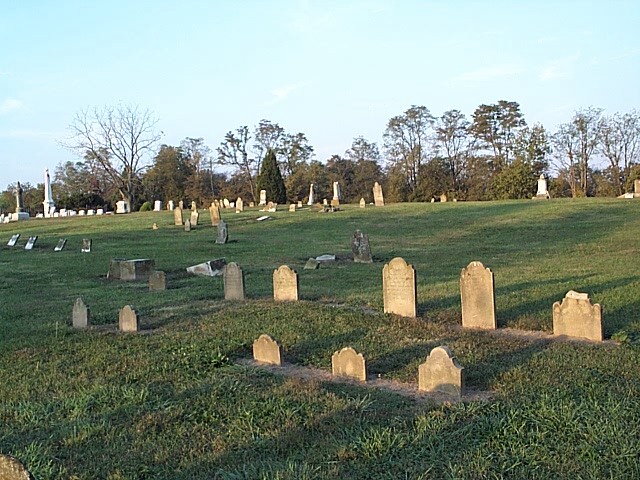
| Lewis Gordon family gravesite, Old Washington Cemetery |
In July of 1805, Lewis's younger daughter Mary died at only seven years of age. This was followed just over a year later, in October 1806, by the death of Abigail, seventeen years old. Diseases and epidemics were not unusual in those days, with typhoid, cholera, and even malaria often claiming many lives. Today we think of malaria as some sort of tropical disease, but when Lewis and Clark stopped at Limestone in 1803 on the first stage of their journey down the Ohio River, they were very concerned about contracting malaria along the way. Whatever the cause of death of his sisters, Peter and Susan were now the only surviving children in the household.
The first mention of Susan that we have found was a marriage bond that was signed in 1821 by her brother, Peter, verifying that she was over 21 years old (she was actually 26). Susan married Ralph Jenkins, who lived on a nearby farm. Ralph was a carpenter by trade, and he an Susan later moved across the river to Ripley, Ohio. They had two sons for certain, and possibly three other children, and there are some records of their descendants for a couple of generations. It was only in 2002 that Susan and Ralph's graves were discovered in Maplewood Cemetery in Ripley. This Jenkins line is definitely an area for further research.
As far as we can tell, Lewis and Keziah remained either on the farm or living in the immediate area for the rest of their lives. Keziah died in 1841 and Lewis in 1844; both were 82 years old at the time of their deaths. They are buried today, along with their two daughters, in the Old Washington Cemetery, which is along U.S. Rte. 68 just south of Maysville, across from the Old Washington historical district.
Peter Gordon
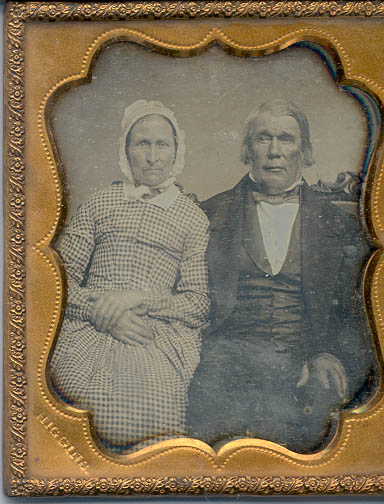
| Daguerrotype of Peter and Clarissa Gordon |
Research also remains to be done on the details of Peter's life, but we do know something about his family. When he was 31 years old, he married Clarissa Berry Loyd on Jan. 30, 1832. Clarissa was the daughter of Dixon Loyd and Clara Berry, who were both descendants of the original Simon Kenton party from Faquier Co., Virginia. From 1832 to 1848 Peter and Clarissa had six children, in order as follows: Susan Elizabeth Gordon (1832), Anna Eliza Gordon (1836), Mary Keziah Gordon (1839), Lewis Dixon Gordon (1842), Peter Albert Gordon (1844), and Clara Ella Gordon (1848). Notice how various family names were passed on to the children, as was the custom of the times.
Peter must have worked the family farm that had been established by Lewis. The census records of the time show him listed with occupation "farmer" and the children living with him until their marriages. Property deed records also indicate that he made quite a few land transactions in the 1840's and into the early 1850's. Some of these appear to have been more in the way of land "speculation" rather than to expand his own farm. Perhaps he was becoming something of a local real-estate magnate.
Peter died on Nov. 20, 1853 at the relatively young age of 52, of unknown causes. He was buried on a new family plot in the main Maysville cemetery. The position of his gravesite and the monument thereon would seem to indicate that he was a reasonably prominent person in the community. The statement of his personal property that was drawn up for the courts by Clarissa shows that he had a number of "notes" (investments) due him at his death, plus a number of personal items and farm equipment. It also shows that he had what appeared to be a family of slaves that must have worked on the farm. The entries for this "property" along with their "assessed values" are as follows:
| Negro Man Daniel
Negro Woman Ann Harriet Ann Elizabeth Daniel Martha Bell William Alonso Henry White |
Aged 37 years Aged 34 years Aged 15 years Aged 13 years Aged 11 years Aged 9 years Aged 7 years Aged 4 years |
600.00 |
The total evaluation of his personal property was $7330.67, exclusive of house and real estate. Peter's death must have thrown the operation of the farm onto Clarissa, as his oldest son was only eleven at this time. Clarissa lived until 1870, and it was not until about that time that it appears that most of the tracts of land in Mason Co. were sold. In the 1860 and 1870 censuses, it is Lewis Dixon that is shown as the "head of household," occupation "farmer," but Clarissa was also still living there. Lewis's brother, Peter Albert, became a physician but never married; he died in 1891 at only 47 years of age.
In the 1860's and 1870's most of Peter's children married. Anna Eliza married Darius Downing, who was known as one of the largest landowners in the county. They had two sons and a daughter. The daughter, Ella, married James Edward Parker in 1892. Some distant Parker cousins are still in contact with us today. Mary Keziah married William Perrine Smoot, and Clara Ella married his brother Samuel Smoot. We do not have extensive records of the descendants of these marriages, but it should be noted that the names "Peter" and "Gordon" were passed down to a number of them along the way. Neither Peter Albert nor Susan Elizabeth ever married; they are buried along with Peter and Clarissa in the Maysville cemetery, with the Smoot and Downing family plots nearby.
Lewis Dixon Gordon
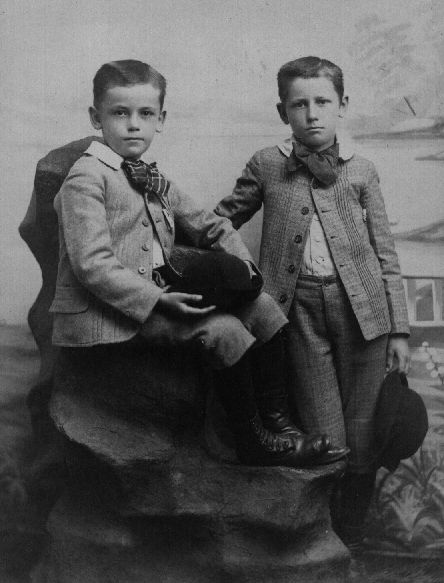
| William and Albert Gordon in Lamar, Missouri |
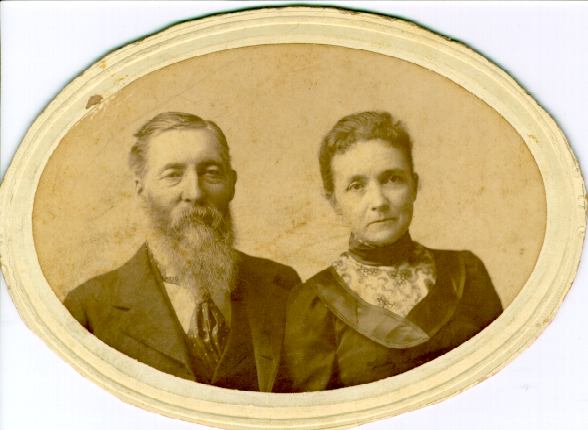
Lewis Dixon Gordon married Lucy Grace Quaintance on Dec. 4, 1877. At this time, he made the decision to move to Flemingsburg and take up residence on the William S. Quaintance farm, in the beautiful manor house that still stands there today. Since his brother, Peter Albert, was a doctor and not a farmer, this event must have sealed the fate of the original Gordon farm in Mason Co. There are indications of some final sales of land by Lewis in the 1870's, and thus ended our Gordon family's sojourn in that county.
In this generation of the family, the siblings seem to have been quite close to each other, as well as with their extended families. More and more material is coming to light concerning their social and professional associations. For example, Dr. Peter Gordon took his nephew Dr. Peter Gordon Smoot into his medical practice in Flemingsburg for a while. Also, Samuel Smoot and his wife Ella Gordon moved to Barton Co., Missouri, where he was noted in local history as a land owner and stock raiser. Lewis and Peter soon followed him to Missouri.
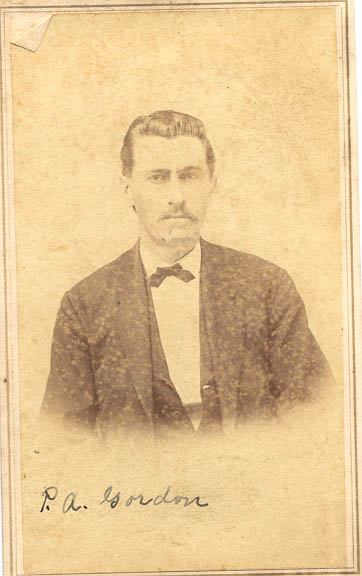
| Dr. Peter Gordon |
Dr. Peter Albert Gordon purchased some land in Barton Co., Missouri, and in 1887 Lewis moved his family to Lamar, Missouri to work the farm in partnership with his brother. By this time, Lewis and Grace had two sons, Peter Albert Gordon and William Lewis Gordon, who were 8 and 6 years old at that time. While visiting them in 1891, Dr. Peter Gordon died unexpectedly and Lewis was forced to sell the farm to settle the estate. The family then returned to Kentucky in 1892.
Finally, around the turn of the century, another move was made downriver to Cincinnati, Ohio. The house and land in Fleming Co. was sold in 1901. Our family's story through the 1900's then took place mostly in the Cincinnati area.
| Lewis D. and Grace Q. Gordon |

