

Military History
Wars have often marked significant turning points in world history. Today I would hope that our family members have been involved in their last war, but we should also remember those who took part in them in the past. Through their involvement in these conflicts we can make a personal connection to what we read in the history books.
Wars for Scottish Independence
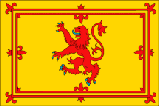
| Scottish royal flag |
If nothing else, the series of battles and wars between Scotland and England were a long and bloody affair. Even if our specific connection to the old Gordon clan is not completely established, there is no doubt that a number of our ancestors fought and died in these clashes. The movie Braveheart notwithstanding, the Scots were generally on the losing end in most of the major battles.
Looking at the Gordon history from this period, there is a definite pattern of the mature males in each generation being killed somewhere on a field of battle. With luck, as in our case, they were able to leave some children behind to carry on the family name.
Adam Gordon, a descendant of the family founder, reportedly fought a hand-to-hand battle with Prince Edward, "Edward Longshanks," later King Edward I of England. The outcome was a draw. Edward later led most of the armies that were involved in the conflicts of the early 14th century against Robert Bruce. Adam's father Sir Adam Gordon had also taken part in the 7th Crusade led by Louis IX of France, and died about 1270 while enroute to the Holy Land.
The better known Sir Adam Gordon (1285-1333), contemporary of William Wallace and Robert Bruce, led the Gordon warriors at the Battle of Bannockburn on June 23-24, 1314, one of the only victories that Scotland scored over England in a set-piece, pitched battle. Bannockburn is the name of a small stream (a "burn") in the vicinity of Stirling Castle, northwest of Edinburgh. Adam was later killed in the Battle of Halidon Hill in Berwickshire on July 19, 1333.
Adam's grandson, John Gordon, was killed in the Battle of Otterburn in nothern England on August 19, 1388. The Battle of Flodden, where a later John Gordon was killed on September 9, 1513 was particularly disastrous for the Scots since most of the nobility who took part were killed. Even the king, James IV, was killed when a nearby cannon accidentally exploded. And finally, there was the Battle of Pinkie Cleugh on September 10, 1547 where yet another John Gordon, grandson of the previous John Gordon, was killed by the forces of Henry VIII.Revolutionary War
We had several ancestors that took part in this conflict. Almost nothing is known about their length or type of service, or any actions that they might have taken part in. The following are definitely documented as Revolutionary War veterans:
- Isaac Darnall (1731-aft.
1778), who served in the militia of Maryland.
- Robert Armstrong (1724-1811), who served in a regiment of the Virginia militia.
Note that Robert was 52 years old when the war started in 1776. However, this was not unusual since the militias were loosely organized, with men often mustering in and out depending on what services were required. In addition, the following of our ancestors are listed as having been in the war, but have not been located in the official records to date:
- Abram LeForgee (1740-1803).
- John Stout (1730-1798).
Our ancestor Lewis Gordon was too young to have served in this war, but his older brother Peter Gordon served as a Brigade Major in the New Jersey theater of the war. He also served as Quartermaster in the Trenton area, and there are numerous official documents related to his activities in that capacity.
War of 1812
This is one of the lesser-known wars in our country's history, but upon closer study there were many interesting events during the war that occurred right in our area of the country (Kentucky, Ohio, Michigan). The British, under General Henry Procter at Fort Malden (Amherstberg, Ontario) had captured the fort and settlement at Detroit and were allied with an Indian confederation put together by the famous Shawnee leader Tecumseh. They were trying to control the potential expansion of the fledgling United States into the territory of northwest Ohio, Indiana, and Michigan. Opposed to them, the U.S. forces were led by Gen. William Henry Harrison, who was later elected President in 1840.
Our military ancestor in this war was William Quaintance (1785-1867), who served as a private under Capt. Joseph C. Belt in the 4th regiment of Pogue's Volunteer Militia from Fleming Co., Kentucky. Interestingly, in one roster listing he is noted as being a "substitute for Samuel Rodes," an expression that usually means that he was paid by the original militia member to take his place in the service. The record that we have simply indicates that he served in "northern Ohio," but this almost certainly means that he was stationed at Fort Meigs.
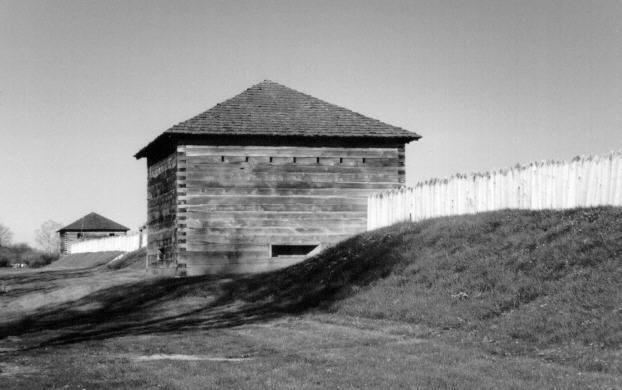
| Ft. Meigs, as restored at Perrysburg, Ohio |
Fort Meigs is located on the Maumee River just outside of present-day Toledo. Interestingly, it is not far from the site of another famous battlefield where an Indian alliance was defeated by Gen. Anthony Wayne at the Battle of Fallen Timbers in 1794. During the War of 1812, this fort was established by Harrison and garrisoned mainly with soldiers from Kentucky and southern Ohio. The Kentuckians had a particular enthusiasm for enlisting because an earlier force from their state had been defeated at the Battle of the Raisin River near present-day Monroe, Michigan. The night after the battle, a group of intoxicated Indians massacred a large number of wounded soldiers, making "Remember the Raisin" a rallying cry for recruitment.
Most of the time spent at Fort Meigs was probably filled with boredom for the majority of the soldiers. However, there was one period of intense action in April of 1813 when a large force of British and Indians marched from Amherstberg up the Maumee and laid siege to the fort. There was an exchange of artillery fire and a couple of major assaults, but the fort held. In the end, the British withdrew and it was viewed as a victory for the U.S. side.
Fort Meigs has been restored on its original site as an Ohio historical park, although it is now surrounded by modern subdivisions instead of by redcoats and Indians. The stockade fence and blockhouses are all total reconstructions, but most of the earthworks inside the fort are the originals that were put up by the soldiers during the siege. We will never know exactly what part, if any, William Quaintance played at Fort Meigs, but it is possible that he witnessed some action and saw some of the historical figures of the war.
Another relative who was involved in the war, although not a direct ancestor, was Ayres LeForgee, son of Abram LeForgee and great-uncle of Lucinda Armstrong who married Thomas Darnall. Ayres was with George Matthew's company of the Mounted Kentucky Volunteers. In an article written about Ayres Leforgee, it is stated that he took part in the Battle of the Thames, which was the climactic battle of the war in the old Northwest, in October of 1813.
The Thames River flows from what was then called Moraviantown, near what is now Chatham, Ontario, to the eastern shore of Lake St. Clair, just above the mouth of the Detroit River. A large American force was pursuing the retreating British, who were accompanied by their Indian allies. The British forces finally stopped and made their stand when they reached the vicinity of Moraviantown, but were completely defeated and routed by the much larger American army. It was in this battle that Tecumseh was killed, demoralizing the Indians and causing them to quickly flee the scene.
According to Ayres, he actually saw the body of Tecumseh, who was one of the most famous Indian leaders in history even at that time. He also offers his opinion as to who killed him, but this fact, along with the knowledge of where his body was finally buried, have been disputed by historians ever since. In any case, this battle marked the end of active conflict in this part of the nation.
Republic of Texas
The Battle of the Alamo was of course the most famous action in the War of Texas Independence that occurred in 1836. One of our cousins, Alfred S. Donovan, travelled from Kentucky, enlisted shortly after that battle, and served in the Texas army until 1838. He probably did this partly to claim the land bounty that was offered to outside volunteers. A letter received by a family member a few years later indicated that he had several property holdings in Texas. Another attraction to Texas might have been that the Texas forces were being commanded by Gen. Albert Sidney Johnston, who was born in Mason Co., Kentucky — the place that Alfred was also from. Gen. Johnston later gained fame as a commander of Confederate forces in the Civil War.
In 1841, Alfred again volunteered for army duty, this time as a member of the ill-fated "Santa Fe Expedition." This was a venture intended to possibly annex the New Mexico territory to the Republic of Texas. The expedition ran into trouble from the start, and was eventually captured by Mexican forces and marched to prisons in Mexico from which only a few returned. Alfred, however, was killed in a skirmish with Kiowa Indians on the west Texas plains in August of 1841, only two months into the expedition. His back pay for his services was eventually recovered by his father, who still lived in Mason Co., Kentucky.
The Civil War
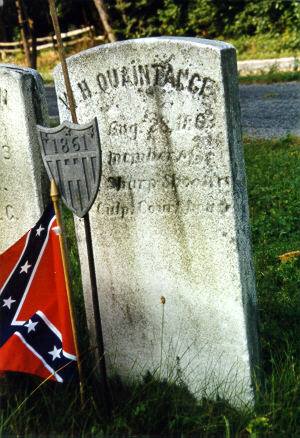
| Grave of Joseph Quaintance in Mercersburg, Penn. |
We have no known direct ancestors who served in this conflict, probably because Kentucky was a border state with no strong allegiance to either cause. Many Kentuckians did serve, but our ancestors were really not of the right age or class to have been likely to volunteer.
On the other hand, we did have some cousins from the old Virginia side of the Quaintances who fought for the Confederacy. According to the records, three brothers, sons of Henry Harford Quaintance, were enlisted in a regiment of the Stonewall Brigade under Gen. Jackson. This unit saw action throughout the war and took part in two of the bloodiest and most significant battles: Antietam (Sharpsburg) and Gettysburg.
It was at Gettysburg that one of them was wounded and shortly afterwards died during the Southern retreat. Joseph William Quaintance, who was from the family branch that remained in Rappahannock Co. Virginia, fought in Robert E. Lee's "Army of Northern Virginia." He died from wounds received at the Battle of Gettysburg and was buried in Mercersburg, Pennsylvania. An excerpt from a letter written to Joseph's father from an acquaintance in the North shows some of the feeling of this conflict between the States:
"... The ball was extracted from his spine a day or two before his death and he sank under the effects. He seemed to be convinced that his case was very critical and his great regret seemed to be that he would have to part with his wife and child. We hear Mr. Leidy's family [who cared for him in their home] were very attentive and kind to him and they have his ring and some of his hair for his friends, and a stone has been put at his grave... He had the consolation of having a Clergyman with him and one attended his funeral service. We hear he made an edifying death and may he rest in peace. Oh my good friend and customer, may the day soon come when this cruel war which is bringing so much woe and sorrow to so many families be over. May God in His mercy hasten it..."
His gravesite, which includes the graves of two other Confederate soldiers, is still well-known in the area. On a visit to the cemetery in 1998, the site was found to be decorated with ribbons and Confederate flags. It is likely that this was done by the "Sons of the Confederacy" organization, or by a group of re-enactors.
One mystery in this story is that, although the Quaintance history records the soldier who died as "Joseph W. Quaintance," the grave marker shows it as "W. H. Quaintance." There is clearly a discrepancy here, but no explanation is currently available. Perhaps the initials "J. W." were simply mixed up with his father's name and came out "W. H." Another brother from the same family, John Robert Quaintance, died of typhoid fever while also fighting for Stonewall Jackson.
World War I
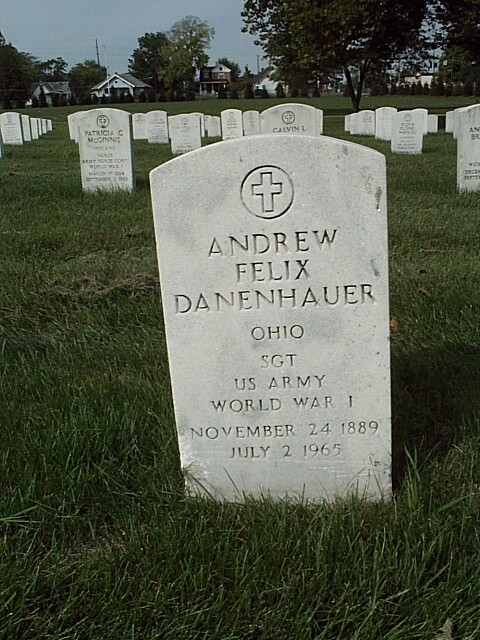
| Dayton National Cemetery |
My family representative in The Great War was Andrew Danenhauer (1891-1965). Due to the circumstances under which he left his family in the 1930s, his wife and daughter spoke little of him, and as a result nothing is really known about the capacity in which he served. Also, a fire in one of the archival institutions in Washington unfortunately destroyed quite a number of World War I service records. He is buried in Dayton National Cemetery in Dayton, Ohio. From his marker, he attained the rank of Sergeant.
World War II
My father, Albert Cedric Gordon (1910-1975), fought in World War II. He was in the 99th Infantry Division which was for a time in the 3rd Army, commanded by the famous Gen. George Patton. This division had just arrived in the combat zone when they saw some of the fiercest fighting of the war in the Battle of the Bulge. They were stationed at a critical point at the edge of the bulge, near Elsenborn Ridge, and were instrumental in preventing a major collapse of the Allied lines. After this battle, they participated in the sweep into Germany, including the crossing of the Rhine River at Remagen.
Expecting to be drafter, Cedric enlisted in the Army in 1942, along with many other men between the ages of 18 and 35. However, in deference to his age (32) and education, he was assigned to a desk job in the training facility at Paris, Texas. As an experienced typist and journalist, he handled paperwork, published the camp newsletter, wrote articles for Stars and Stripes, the Army enlisted men's magazine, and also edited the division's Checkerboard publication. As he took on more responsibilities, he advanced in rank to the level of Sergeant in the 99th Infantry Division.
It was the middle of 1944 when the call finally went out. It was after D-Day and the Germans were being pushed back through France and Belgium, but there were more large offensive operations on the horizon. All available men were needed for the fighting, and it became clear that Cedric would have to ship out with the rest of his division.
His exact movements are not known for sure, but I believe that like most troops he went first to England for a time, even spending some time in London. Shortly thereafter, the 99th shipped over to France and began the trek towards Belgium and Germany, cleaning up behind the troops that had earlier carried out the D-Day assault. He went through a freshly liberated Paris, and reported attending the infamous Folies Bergere, Can-Can dancers and all. After this things became grimmer as they finally caught up with the retreating German Wehrmacht.
Battle of the Bulge
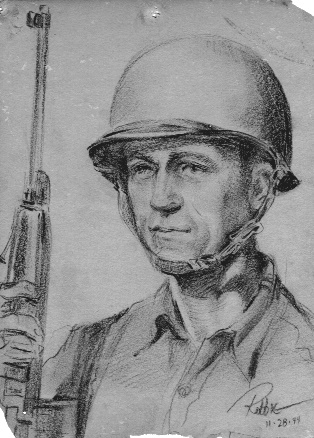
| A.C. Gordon, as sketched by a friend |
The German offensive that was launched in December of 1944 quickly became known as the Battle of the Bulge. The name refers to the "bulge" created in the Allied lines when the entire remaining might of the German Wehrmacht was thrust against its center. Attacking through the Ardennes Forest of Belgium, the Germans came close to severing the Allied line and separating their forces.
By this time, even those who were part of Special Services were close to the front lines and were getting involved in combat situations. On the night before the German offensive started, Cedric was sent on a mission to deliver some papers to a temporary headquarters in an old house in a village close behind the Allied front lines. He did this and, since it was nighttime when he arrived, he was invited to spend the night in an upstairs room. It was during this night that the Germans launched their surprise attack.
Cedric was always a very sound sleeper, and had even slept through a blitz while in London where the building next door was destroyed. When he awoke the next morning he heard movement and activity in the street outside. After listening for a few moments, it dawned on him what was wrong about it: they were speaking German! A quick look out the window confirmed the worst, as the streets were occupied by German soldiers.
Since the houses were probably being searched and there was little chance of escaping in broad daylight, the only hope was concealment. Cedric climbed out of a rear window and dropped to the ground. He was able to find some sort of entrenchment in the back yard into which he crawled and covered himself up as much as possible. It was here that he spent the entire day, in sub-freezing weather, waiting for the cover of darkness.
It was fortunate that he was not captured by the Germans that day. Their army was moving with all possible speed and with minimum provisions for their own men; they could not afford to spend much effort on prisoners. In one infamous incident near Malmedy, a number of prisoners taken during this time not far from Cedric's location were lined up and gunned down by the Germans. In our time we might no longer be surprised by the atrocities of war, but at that time this was considered to be a serious "war crime." I never thought to ask him what happened to the other Americans who had been at the outpost, or why he had not been awakened and warned. Perhaps he never learned of their fates.
After night had fallen, he crawled out of his hiding place and began the long trek back towards his own lines. His feet were numbed from the freezing temperature, and he had to half walk and half crawl along the road leading (he hoped) to safety. Each time that he heard or saw a vehicle coming, he had to dive into the ditch and cover up again. This continued through most of the night until he came to an encampment and was challenged by the guards - in English. He had made it back to American-controlled territory!
By this time he was in serious trouble, probably from what we would call exposure or hypothermia. He was transported to a field hospital where they immediately turned their attention to the condition of his feet, which were quite frozen by then. He told me how he feared waking up the next day, not sure of whether he would still have his feet. This was a justified fear, as frozen feet and subsequent amputations were not unknown during this harsh campaign. In any case, he recovered and was later sent back into action. For this incident he was awarded the Purple Heart medal, but forever afterward his feet were particularly sensitive to cold temperatures.
The Bridge at Remagen
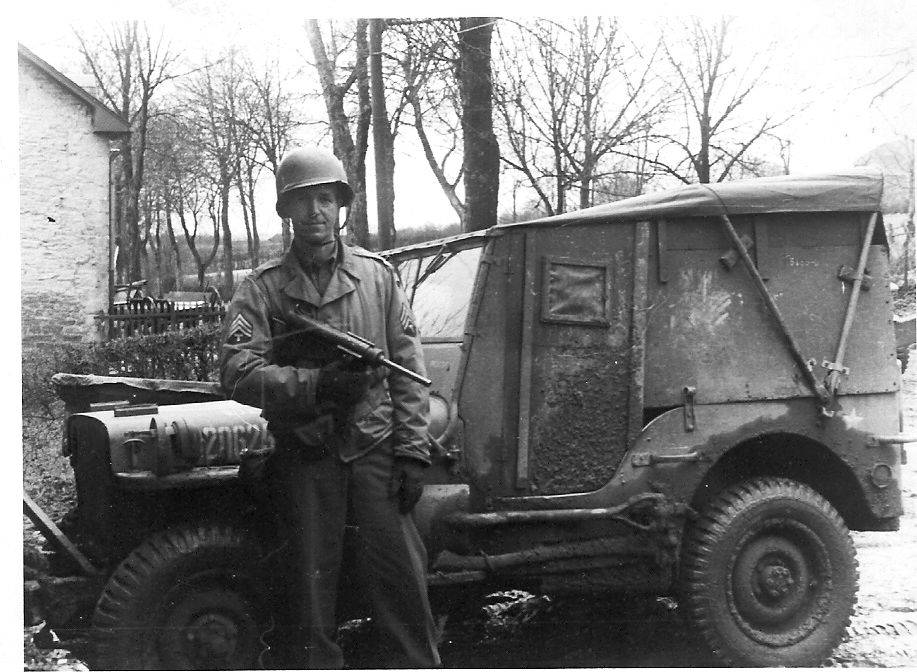
| Somewhere in Germany, 1945 |
Another famous action in the War in Europe was the crossing of the Rhine River at Remagen. By this time, the Germans were being pushed back into their own territory, and it was obvious to most that it was only a matter of time before the Allies were in Berlin. However, the crossing of the Rhine River itself was one of the significant advances that the Germans were still determined to stop at all costs.
At Remagen stood one of the bridges that was still relatively intact, and it was a bottleneck through which the Allied forces would have to pass. Crossing a bridge is a risky affair for an army, since it must necessarily be strung out into a thin column in an exposed place as it makes the crossing. This bridge was also under constant shelling from the Germans who were entrenched on the other side, and it was only a matter of time until the bridge became unusable.
Cedric's platoon was one of the last ones to cross the bridge before it collapsed. On the other side was a railroad tunnel in which they were taking shelter while trying to return the Germans' fire. As they ran towards the tunnel, one of his comrades went down under machine gun fire. Seeing this, Cedric headed back, picked up the fallen man on his back, and carried him into the tunnel where the medics were stationed.
Shortly after this, the bridge finally collapsed under heavy bombardment. The Engineer Corps then brought up some special equipment and constructed a pontoon bridge across the river so that the rest of the troops, tanks and other equipment were able to cross the river and eventually rout the German defenders. Although the soldier that he carried in later died from his wounds, Cedric was awarded a Bronze Star for his actions.
The War Ends
There were some other close calls that occurred in the course of finishing up the war. In one case, he was about to go check out a jeep from the motor pool when a German V-1 "buzz bomb" missile came down and destroyed several of the vehicles; "God was with me that day," he wrote in a letter to his mother. There were some other incidents with exploding shells and a minor shrapnel wound, but he made it through to the end, with one of the last achievements of his division being the liberation of one of the subcamps of the Dachau labor camp complex.
As part of the occupation period, his unit apparently spent time in Nürnberg (Nuremberg). In one photo, a friend of his is standing inside a stadium that was built by the Nazi regime; I saw this stadium on a business trip a few years ago and recognized it immediately. There were also pictures of the central part of the city which had been reduced to rubble by intensive Allied bombing; again, this is a part of town that I saw in its now restored state without knowing that Dad had been right on that spot 45 years earlier. In fact, I stayed at a place called the Grand Hotel which is right outside the old city walls. A brochure on the history of the hotel indicated that it had been used as the Allied Headquarters for several years after the war. If Cedric was stationed in Nuremberg, it is not unlikely that he might have visited the HQ building - another interesting coincidence.
Since the 99th Division had paid its dues in the final European campaigns, they were not kept long doing occupation duty before they were relieved by fresh troops and were "shipped out." Things were looking up for the veterans already, as they spent some time back in England before returning to the States. I remember Dad telling me that he had been A.W.O.L in London for about two weeks while he was stationed there. At this point, nobody cared about the fine points of Army discipline and I am sure that the celebrations were something to see!
